Ohio
Akron Bets $8 Million That Polymer Know-How Can Build What Comes Next
By Terrence Okafor · July 3, 2026
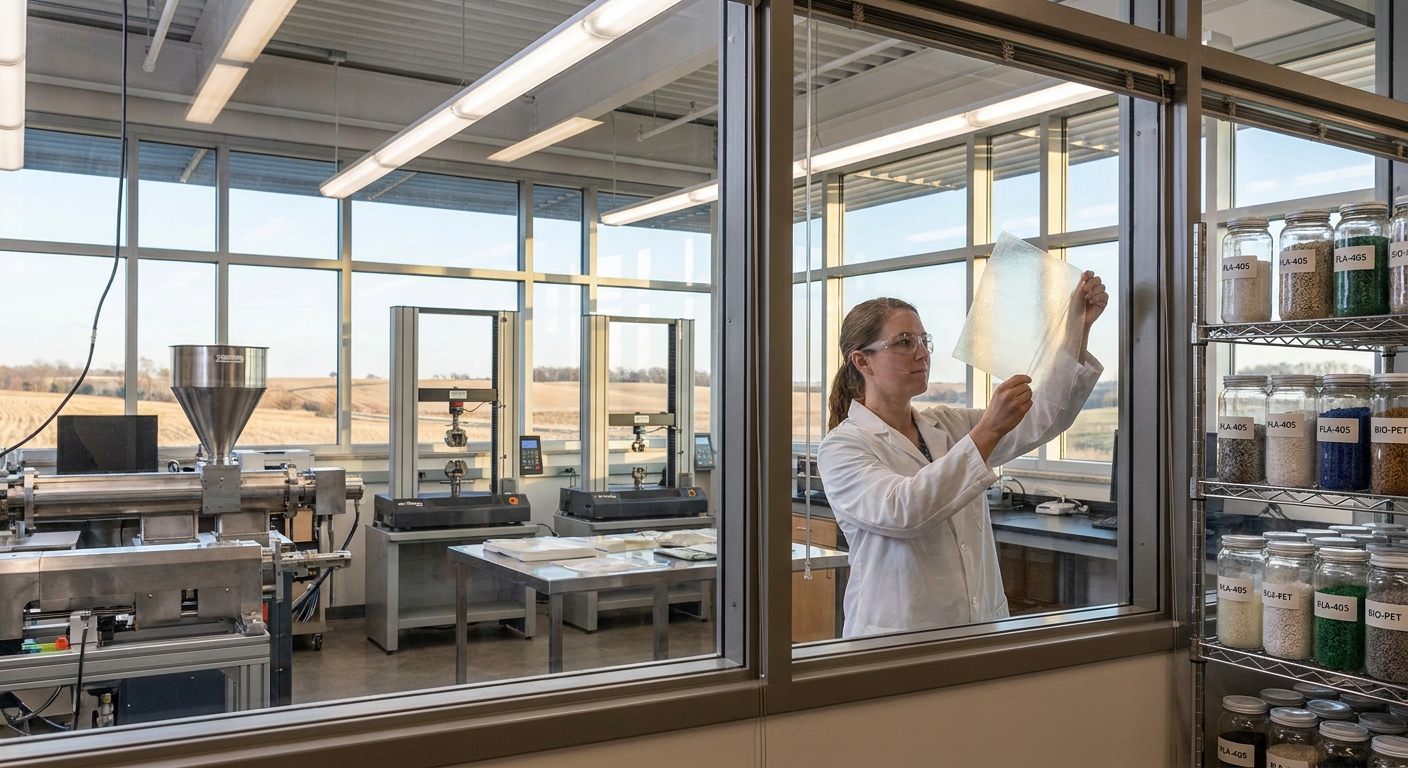
The Polymer Industry Cluster's Greater Akron Polymer Innovation Hub is funding seven new innovation projects with $8 million in combined state and local funding—$6 million in state Innovation Hub money over four years and $2 million in local matching funds. The premise is direct: a city that spent a century mastering the chemistry of rubber can apply that expertise to medical devices and sustainable materials that markets actually want in 2025. Akron earned its title as the Rubber Capital of the World through a polymer industry dating to Charles Goodyear's 1839 discovery of vulcanization and Dr. Benjamin Franklin Goodrich's move to the city in 1870. Today it's known as Polymer Valley, home to approximately 400 polymer-related companies in the region, including 94 in Akron itself, with corporate headquarters and research centers for Goodyear and Bridgestone.
The seven projects—five new R&D initiatives and follow-on funding for two startups—span medical technology, waste-to-fuel conversion, biodegradable packaging, renewable chemical production, recyclable film additives, and sustainable CO₂-based polymerization. With them, the Hub's total portfolio reaches 13 innovation projects. The Innovation Hub provides translational R&D grants of up to $500,000 per project to accelerate polymer innovations from concept to commercialization. That's seed money, not scale money—enough to prove a concept, not to build a factory.
Auxilium Health, a medical technology startup founded by University of Akron alumnus Isaiah Kaiser, is developing a bio-based aerogel wound dressing that heals wounds while detecting infections in under one minute through a rapid color change. PolyKinetix, a second-generation recycling company with operations in Massillon, Ohio, converts waste plastics and end-of-life tires into petrochemical and lubricant precursors using a continuous, self-cleaning pyrolysis process. Peak Nano is developing biodegradable, multilayer nanolayered polymer films for food, beverage, and medical packaging using its proprietary NanoPlex technology developed at Case Western Reserve University.
"We can now design biodegradable nanolayer structures that give converters the barrier and mechanical properties they need, with a much better end-of-life story," said Dr. Michael Ponting, Peak Nano's Chief Scientific Officer.
The University of Akron's School of Polymer Science and Polymer Engineering, led by Dr. James Eagan, is synthesizing sustainable copolymers from carbon dioxide and butadiene, incorporating up to 29 wt% CO₂ content into biodegradable plastics. The team discovered a pathway to incorporate CO₂ into traditional olefin chains, creating a site for biodegradation—a property never previously observed in olefin plastics. Promerus LLC, an Akron-based subsidiary of Sumitomo Bakelite Co. Ltd., is scaling production of green dicyclopentadiene (DCPD) from renewable biomass for advanced polymer products.
The technical ambition is real. But the Hub was established in September 2024 and is still in its early implementation phase, with no publicly released commercialization outcomes yet available. More than 90% of government-backed innovation hubs fail to sustain themselves after initial funding, according to economic development research—not for lack of talent or ambition, but because of strategies built on the wrong foundation.
The most successful emerging ecosystem programs are designed around region-specific existing strengths, rather than trying to replicate an idealized external model. Akron's polymer cluster pairs the University of Akron's polymer science program with Case Western Reserve University's advanced plastics processing technologies and corporate R&D from Goodyear and Bridgestone—a concentration of expertise uncommon outside the region. The Greater Akron Chamber received an additional $6.4 million—$3 million from the U.S. Economic Development Administration's Good Jobs Challenge and $3.4 million in local match—to bolster workforce training, with a goal of placing 320 people into entry-level and advanced manufacturing roles. Beyond the $8 million in new project funding, the Hub received $31.25 million from Ohio's Innovation Hubs Program, matched by $10.4 million in local investment, with the project expected to catalyze $68 million in additional industry investment. The broader Sustainable Polymers Tech Hub, which includes the Innovation Hub, received a $51 million federal award supporting polymer innovation in Northeast Ohio.
Project partners anticipate nearly 2,400 new jobs in the Akron metropolitan statistical area by 2031. The broader Tech Hub is expected to generate over $5 billion in economic impact and create or retain more than 4,000 jobs. Those are projections, not outcomes. The challenge is bridging the gap between $500,000 translational grants and the scale of investment required to move innovations from lab prototypes to commercial manufacturing—a transition where many promising technologies falter.
Akron is making a measurable bet—$8 million in new project funding, backed by more than $90 million in broader hub and federal investment—on translating a century of polymer expertise into next-generation industries. The structural ingredients are in place: concentrated expertise, university research capacity, existing industry presence, and coordinated public investment across state and federal sources. The outcome remains genuinely uncertain—the distance between seven funded projects and sustained economic transformation is vast, and most innovation hubs never make it. What's worth watching is whether Akron's bet on building from existing strength—rather than chasing an imported model—proves enough to beat the odds. The city has its shot. Now comes the hard part.