Ohio
Does the Chamber's Economic Blueprint Speak to Cities That Are Both Rust Belt and Recovery?
By Marcus Jeffries · July 5, 2026
The Ohio Chamber of Commerce Research Foundation unveiled its updated 2026 Blueprint for Ohio's Economic Future in June 2026, developed in partnership with Accenture. Designed as a roadmap to strengthen Ohio's competitiveness, the Blueprint will guide policy solutions intended to drive economic growth over the next decade.
But the question for mid-sized manufacturing cities like Dayton, Canton, and Toledo is whether this Columbus blueprint understands their messy hybrid reality—simultaneously factory floor and college incubator, legacy equipment and workforce reinvention. The real test is whether the plan speaks to places living both realities at once, or only to metros that fit cleaner categories.
What Columbus Is Prescribing
The Blueprint organizes its recommendations around six core drivers of competitiveness: Education & Workforce, Infrastructure, Taxes & Costs, Business Friendliness, Innovation & Collaboration, and Sense of Place.
On workforce, it proposes a Work and Learn Ohio program to connect 50,000 college students per year with Ohio-based employers through paid internships, externships, and co-ops over a five-year public-private partnership. It also calls for teaching computer skills and coding in high school curricula to prepare students for the digital economy.
On infrastructure, the Blueprint calls for investing in transportation networks and digital infrastructure to connect communities and maintain Ohio's competitiveness in the global economy.
It recommends comprehensive tax reform to modernize a system last reviewed nearly 20 years ago and simplify municipal income tax complexity across Ohio's 848 local taxing jurisdictions. Ohio currently ranks 2nd in Cost of Doing Business but 25th in State Business Tax Competitiveness, indicating room for improvement.
Workforce Theory Meets the 18-Year-Old's Reality
Manufacturing offers Ohio workers with high school diplomas $2.99 per hour more than other sectors, yet employers in mid-sized cities struggle to find skilled trades workers despite high-tech facilities promising good jobs for people with fewer formal degrees. High school programs encourage students to pursue four-year degrees rather than promoting trades as viable careers, and stakeholders report insufficient awareness of existing workforce development incentives.
The Blueprint's Work and Learn Ohio program targets college students, but it's unclear how that helps the high school graduate weighing a one-year certificate versus immediate plant employment. Columbus State Community College leads a statewide strategy to fill approximately 2,000 non-degreed jobs via stackable one-year certificates and curriculum-enhanced engineering programs.
Ohio has reduced employer liability for minors in work-based learning by removing workers' compensation claims, offering temp agency hiring options, and providing income tax credits for businesses employing career-technical students under 19. These practical mechanisms exist, but the Blueprint's emphasis on coding and computer skills may not align with the skilled trades reality that mid-sized manufacturing cities need most urgently.
Infrastructure: What Gets Built and Where
The Blueprint calls for reforming rapid transit to reach eight important counties in key regions, enabling people to travel from where they are to where they want to work. It specifically calls for expanding rural broadband access, highlighting Low Earth orbit satellites combined with free-market investment as a game changer for rural connectivity. And it emphasizes a more reliable power grid and sustainable infrastructure—renewable electricity, high-capacity electric distribution, green hydrogen, and carbon capture—to support long-term manufacturing viability.
It also addresses barriers to workforce participation by calling for improvements to transportation and childcare access, which directly impact whether workers in mid-sized cities can reach manufacturing jobs.
What's missing: specific mention of rail spurs, industrial park connectivity, water and sewer capacity for legacy manufacturing districts—the unglamorous bones that determine whether a mid-sized city can actually land a plant expansion.
Cities That Don't Fit One Archetype
Ohio's mid-sized legacy cities face challenges similar to larger cities—poverty and housing instability—but show fewer signs of recovery, making targeted programs critical for economic inclusion.
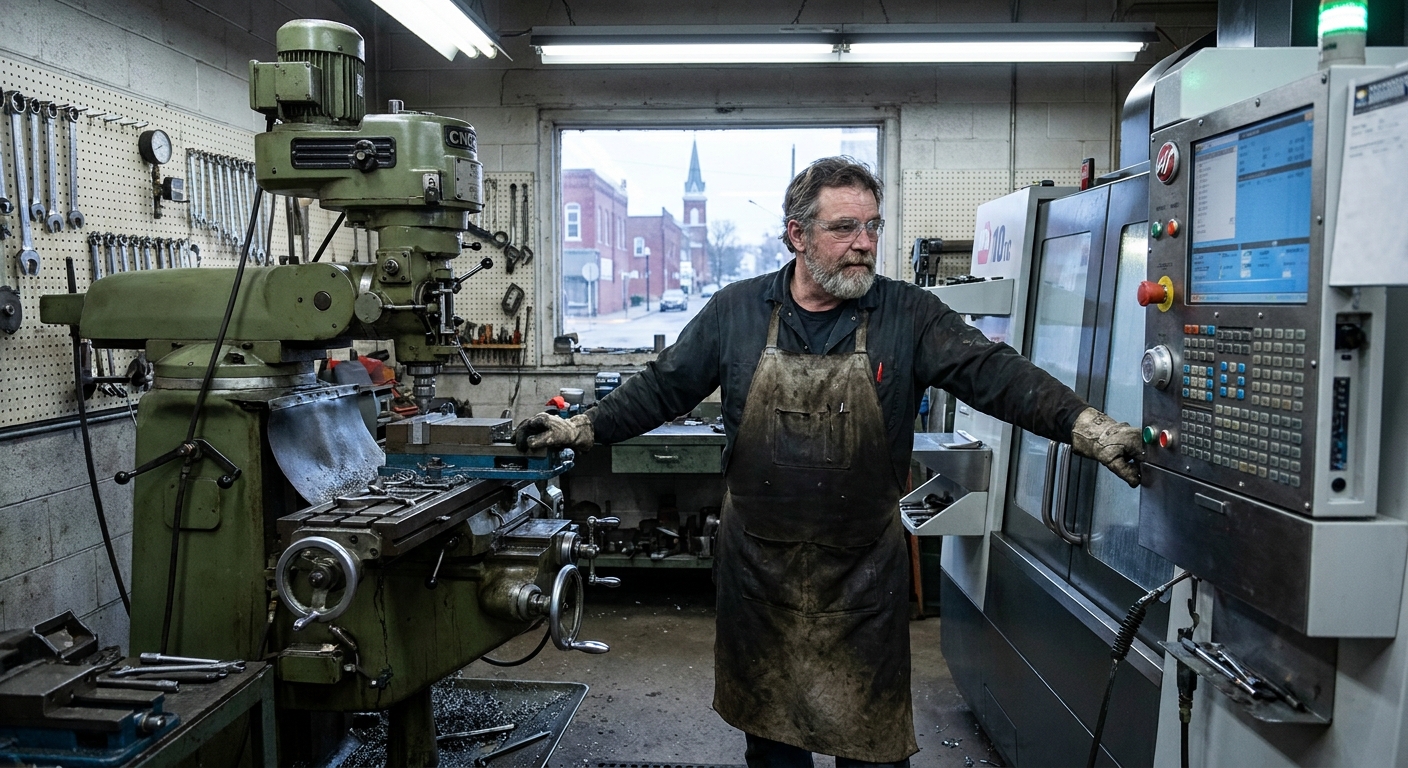
Steve Stivers, president and CEO of the Ohio Chamber of Commerce, notes that 53% of Ohio manufacturers have 10 employees or fewer. Many of those small manufacturers operate on legacy equipment 50 years old or older, which risks becoming irrelevant as the industry shifts to computer-assisted design and tighter tolerances, according to Stivers.
The Blueprint proposes an Ohio Manufacturing Innovation Grant program to subsidize capital costs for small manufacturers to acquire new equipment that ensures viability for the next 20 to 50 years. It also proposes stapling Green Cards to diplomas for foreign graduate students and offering incentives to companies that hire immigrants to fill workforce gaps.
The contradiction is plain: the same blueprint that wants to retain college-educated immigrants also needs to help the 10-employee machine shop survive modernization—and it's unclear whether one strategy can serve both constituencies simultaneously.
Budget Mechanisms: Teeth vs. Aspiration
The JobsOhio Inclusion Grant is the primary funding opportunity that explicitly targets small to medium-sized manufacturing companies with annual revenues up to $25 million for innovation and inclusion projects, offering reimbursement-based support. Governor DeWine announced $3.2 million in grants for manufacturing-focused career-tech programs in June 2026. Federal funding of $125 million from the CHIPS and Science Act supports workforce training for semiconductor facilities, while WIOA funding targets apprenticeship expansion to address middle-skill job shortages in Ohio manufacturing. The JobsOhio Vibrant Communities Program assists distressed small and medium-sized communities in implementing catalytic development projects, which can include workforce development as part of economic revitalization.
But the Blueprint's ambitious proposals—50,000 internships, comprehensive tax reform, modernized rapid transit—don't yet specify funding sources or implementation timelines beyond these existing state and federal grant programs.
Stivers warns that artificial intelligence could displace up to 40% of the workforce. The Blueprint's response is to establish a working group on artificial intelligence to manage potential displacement and encourage lifelong education. A working group is aspiration; retraining grants with defined eligibility and dollar amounts would be implementation.
What Local Leaders Should Ask When the Roadshow Arrives
The Ohio Chamber is promoting the 2026 Blueprint through a Blueprint Roadshow to engage stakeholders across Ohio with actionable strategies.
What works for mid-sized manufacturing cities: the Manufacturing Innovation Grant for small shops, tax simplification across 848 jurisdictions, childcare and transportation support, and stackable certificates that don't require four-year commitments.
What's unclear: whether rapid transit reform reaches the counties that include legacy manufacturing metros, whether broadband satellites serve industrial parks or just rural residences, and how a college internship program helps the non-college workforce pipeline.
What's missing: acknowledgment that mid-sized cities face slower recovery than larger metros, infrastructure specifics for industrial districts, and reconciliation between preparing for AI-driven displacement and immediate skilled trades shortages.
The questions local leaders should press: Will the Manufacturing Innovation Grants be scaled to match the number of small manufacturers who need them? Does infrastructure investment prioritize the counties where legacy manufacturing remains viable? And can workforce strategy serve both the 18-year-old who needs a certificate program and the 45-year-old machinist whose shop just automated?
The Blueprint gets the diagnosis right—Ohio's hybrid economy needs workforce flexibility, modern equipment, and better connectivity—but the prescription is still written in Columbus grammar, waiting to be translated into the language of communities that have heard economic plans before.