Education
University of Akron Enrollment Surges 3.4% — What's Driving the Rebound and What It Means for the Local Economy
By Jenna Morales · July 3, 2026
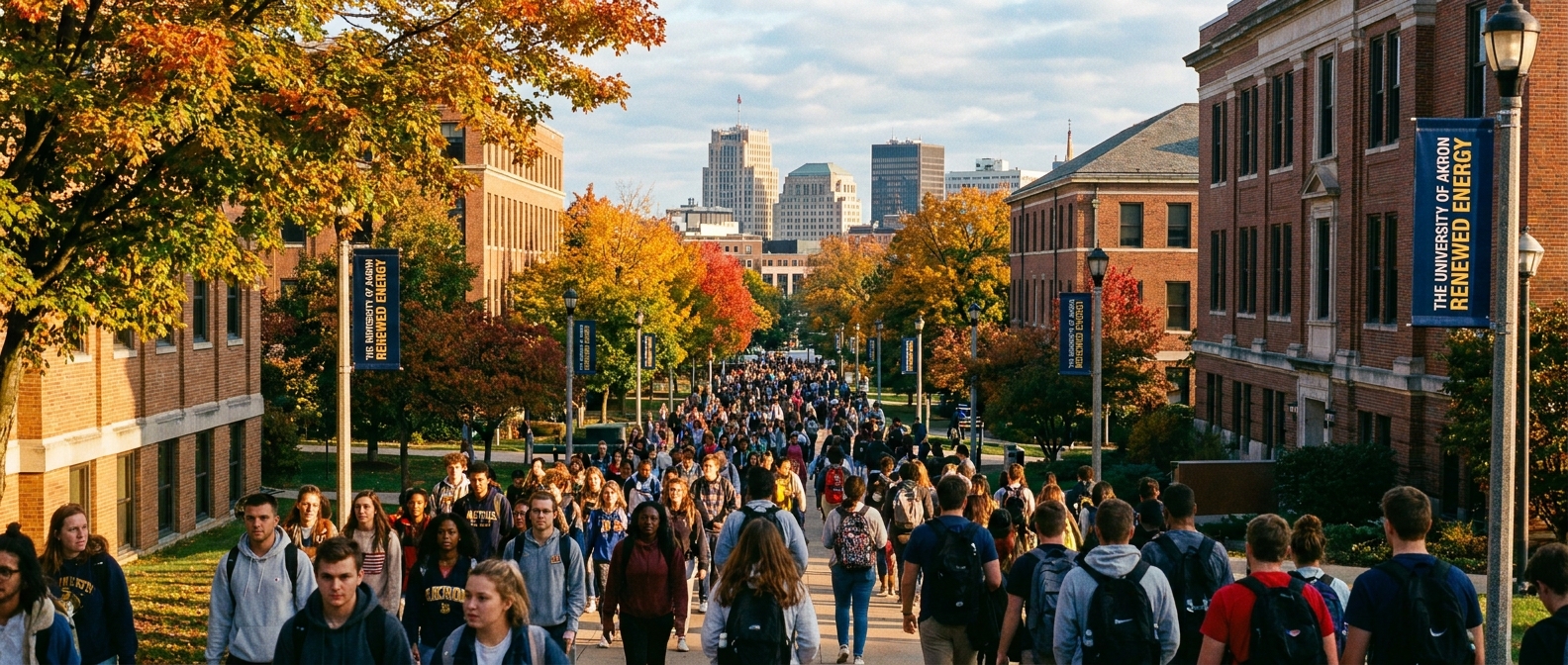
The University of Akron's fall 2024 enrollment reached 15,318 students, a 3.4% increase representing roughly 500 additional students on campus. Five hundred students—enough to fill a mid-sized lecture hall, enough to keep a handful of downtown coffee shops in business, maybe enough to postpone the next round of faculty cuts. For a city that has spent years watching its economic anchor shrink, 500 feels both like vindication and a dare: prove you can hold onto them.
This marks the university's largest year-over-year enrollment gain since 2021, but the growth comes against a grim historical backdrop: UA enrollment has plummeted from a 2010 peak of 29,251 students—nearly double today's headcount—and lost approximately 9,769 students over the past decade alone. President R.J. Nemer called it the "largest UA growth in seven years," describing "incredible momentum at UA".
For Akron—a city that has lost over 34% of its population since 1960 and continues to shrink at -0.06% annually—the university's fortunes are inseparable from the region's economic survival.
Broad-Based Gains, Led by Transfers and First-Years
Enrollment growth spanned undergraduate, graduate, law, and College Credit Plus cohorts, indicating broad-based momentum rather than a single demographic fluke.
Transfer students showed the strongest gains: the main campus saw over 10% growth in transfers, while the Wayne campus experienced a 15% increase. Full-time, first-year students on the main campus rose from 2,055 to 2,237, a 9.7% increase—the largest jump since 2021. Incoming first-year, full-time students at the Wayne Campus surged 11.19%, marking the regional campus's largest incoming class since 2021.
The university received 18,025 undergraduate applications in 2024, a 20.3% annual increase, suggesting growing interest in UA as a destination.
What Changed—and Whether It Can Last
The enrollment increase followed significant decisions on faculty and program offerings in the prior academic year, suggesting improved operational efficiency helped stabilize the institution. UA launched a new "Yes" branding campaign to reframe its identity around innovation and opportunity—a messaging shift credited as one factor driving growth.
The growth also coincided with the passage of Ohio's Senate Bill 1, the Advance Ohio Higher Education Act, which mandated the elimination of DEI offices and required transparency in program costs and outcomes. The bill took effect in June 2025, and all 14 public universities in Ohio suspended DEI programs, closed 24 identity centers, and cut low-enrollment majors to comply.
President Nemer attributed the rebound to "the dedication of our faculty and staff," emphasizing internal effort over external policy alone.
The university is finalizing a $161 million public-private partnership to privatize and modernize its 2,552-bed on-campus housing portfolio, providing $91.6 million in upfront debt relief and $50.6 million in renovations set to complete by fall 2027.
Retention rates have improved: the overall first-year retention rate rose to 84.03% from Fall 2023 to Spring 2024, and the first-to-first-year retention rate climbed nearly 5% from Fall 2021 to Fall 2022.
How Enrollment Translates to Dollars and Jobs
The University of Akron generates a $3 billion economic impact for Northeast Ohio, representing approximately 1.5% of the region's total gross regional product. Former UA students currently employed in the regional workforce contributed $2.7 billion in added income in FY 2021-22, supporting 36,324 jobs across the six-county service area. Relocated and retained students added $53.7 million in income that same year, supporting 941 jobs.
An estimated 85% of UA's students live off-campus and drive 40% of downtown retail demand, primarily spending on food and beverage. Downtown Akron retailers and restaurants occupy 190,000 square feet of space and generate $38 million per year in sales, with UA students, faculty, and staff forming the primary customer base. Students can use dining dollars at establishments including Trackside Grill, Rob's locations, Street Treats, and Giant Eagle, creating direct financial ties between campus spending and local small businesses.
UA students launched the "Zips Guide to Shopping Small & Local in Akron," highlighting downtown's small businesses and artists.
The Long Shadow: Is 3.4% Enough to Reverse Decades of Decline?
Between 2011 and 2020, UA's enrollment fell nearly 40%, dropping from 25,190 to 15,385 students—a collapse that triggered waves of budget cuts and layoffs. In 2015, the university eliminated over 200 positions due to a $6 million deficit and later faced a $20 million annual athletics deficit. In 2016, Moody's downgraded the university's bonds to negative due to low enrollment, high debt, and pension burdens. In 2020, the university consolidated 11 academic colleges into 5 and cut 97 full-time professors (about 17% of faculty), with disproportionate layoffs of women and professors of color.
Despite the enrollment gain, Fitch Ratings revised UA's outlook to Negative in September 2025 due to operating deficits in FY24 and expected deficits in FY25, underscoring that financial pressures remain acute.
Only 12.4% of Akron residents fall in the college-age bracket, limiting the hometown recruitment pipeline. The broader metropolitan area has shown slight growth, reaching 701,780 residents in 2025, suggesting that while the city center loses population, the region remains relatively stable.
Some officials warned that Senate Bill 1's elimination of programs and identity centers may reduce future enrollment, with recruitment candidates declining offers and citing SB1 as the reason.
Rival institutions including Ohio State and Kent State also reported enrollment growth in 2024, with OSU posting a record 37% three-year increase in first-year students, raising the question of whether UA's gains are unique or part of a statewide trend.
What to Watch Next
Retention will be the first test: UA's current first-year retention rate of 73% exceeds state and national averages, but its 6-year graduation rate of 47% barely edges the 46.43% national average, and its 4-year graduation rate of 29% lags the national mark of 37.92%.
Next fall's enrollment figures will reveal whether double-digit transfer and first-year gains can be repeated or if 2024 was a one-time surge driven by branding, policy changes, and pent-up demand.
Downtown retail occupancy and sales data will show whether 500 additional students translate into measurable increases in foot traffic and revenue. Completion of the housing modernization project in fall 2027 will test whether improved amenities can attract and retain more students, addressing deferred maintenance that has long deterred applicants. And financial stability indicators—operating surpluses, bond ratings, the ability to avoid further layoffs—will determine whether enrollment growth can outpace the structural deficits flagged by Fitch and Moody's.
President Nemer described "several hundred students more" as a milestone. But the 500 students who arrived this fall didn't reverse years of contraction. What they did was buy time—time for better dorms to open, time for retention rates to prove themselves, time for the university and the city that depends on it to demonstrate this isn't just a statistical blip in a long decline but the fragile beginning of something that might last. Next fall's numbers will start to answer whether Akron earned that time or merely borrowed it.