Education
University of Akron Faculty Contract in Limbo as Expired Agreement Extended Day-to-Day
By Rubber City Signal Staff · July 2, 2026
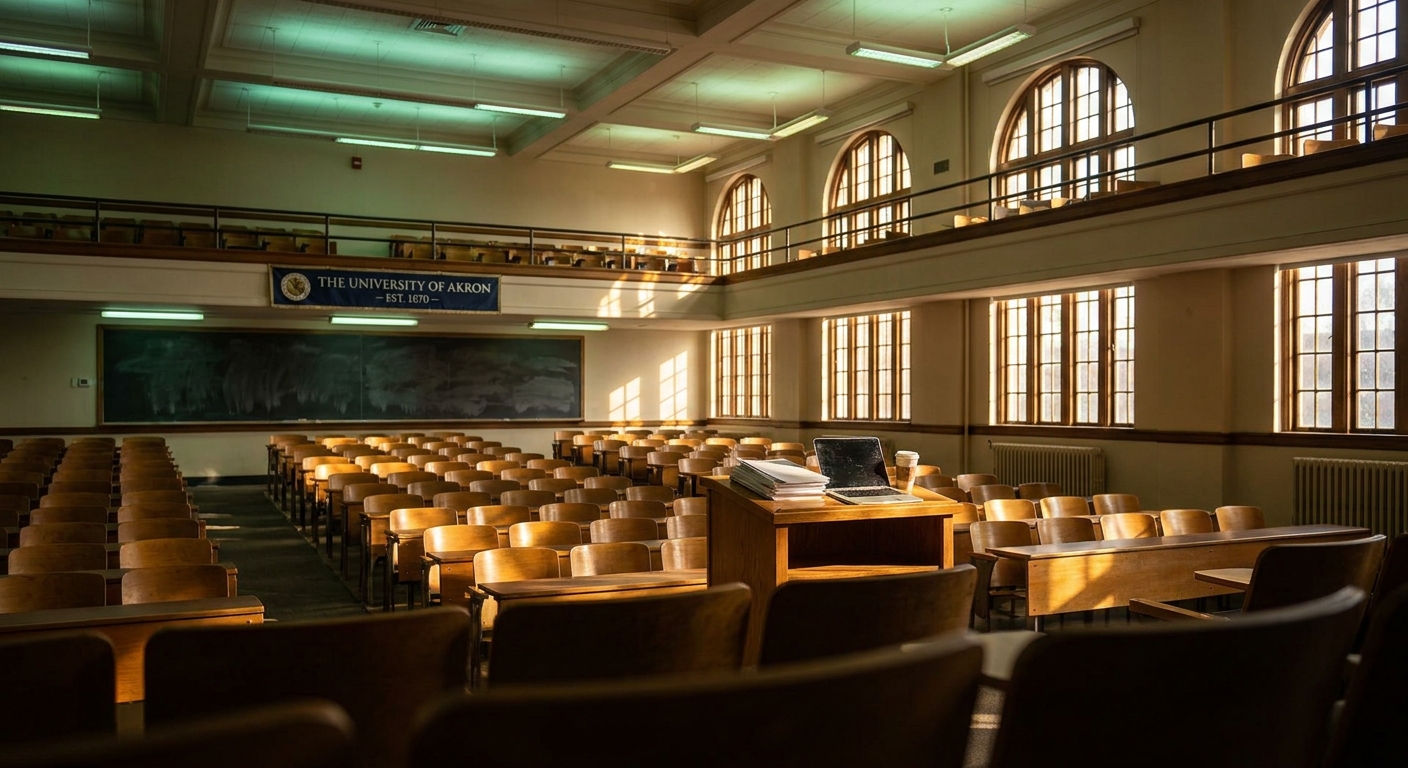
More than 600 University of Akron faculty members walked into their classrooms this semester without a contract. The collective bargaining agreement between the university and Akron-AAUP expired June 30, 2026, and is now being extended on a day-to-day basis by mutual consent while negotiations continue for a successor agreement. The arrangement is not automatic—either party could theoretically end it any morning, creating a state of quiet precariousness for an institution that serves approximately 15,318 students as of Fall 2025.
A Handshake Renewed Daily
Under the extension, all terms and conditions of employment remain as stipulated in the expired agreement—salaries, benefits, and working conditions continue unchanged for now. The agreement represents shared institutional infrastructure, a mutual understanding between administration and faculty on every point, now operating on temporary footing.
Without ongoing mutual consent, employment practices could revert to employer discretion. Negotiations remain active on key articles covering distance learning (Article 20), compensation (Article 16), and benefits (Article 17), while tentative agreements have been reached on professional development leave and intellectual property. The parties have agreed to a fact-finder, Mr. Rob Stein, to assist if negotiations reach an impasse.
What Faculty Are Working For
The faculty unionization effort was originally driven by concerns over falling salaries compared to other state institutions, increased workloads from administrative tasks being transferred to faculty, and unfilled positions. During previous negotiations, Akron-AAUP stated the university's salary proposal was entirely insufficient and regarded increased healthcare costs and aggressive phase-out of retiree spouse/dependent coverage as punitive, unnecessary, and indefensible—issues that animate current talks.
The university initiated a retrenchment process in November 2024 that eliminated 178 positions, including 97 full-time faculty roles, to address a $27 million deficit—context that shapes the current negotiating climate. A previous tentative agreement reached in 2020 included wage reductions of 0-12% depending on salary for one year, with salaries snapping back for the remainder of the 1.5-year term—illustrating the kind of financial concessions faculty have faced.
An Anchor Institution on Uncertain Ground
The University of Akron added $3 billion in income to Northeast Ohio's economy, representing approximately 1.5% of the total gross regional product for the six-county service area. It supports 36,324 jobs in the region—1 out of every 48—making it one of Akron's largest employers.
Enrollment rebounded 3.4% in Fall 2025 to its highest level since 2021, suggesting stabilization after a 34% drop over previous years that, combined with reduced tuition revenue and lower state funding, drove the university's financial crisis. Labor instability at an institution of this size doesn't stay confined to campus—it affects faculty families, student retention, regional workforce development, and the perception of Akron as a stable place to invest and build.
What Happens If the Handshake Stops
The expired agreement includes a no-lockout provision—but that protection exists only while the extension continues. If negotiations fail, unions may resort to strikes; the AAUP states that if the administration implements its last best offer, it must implement the entire offer without cherry-picking articles, and the AAUP would then decide between capitulating or proceeding with a strike.
The university has not issued a public statement directly addressing the expired agreement or faculty contract negotiations in recent reporting periods, leaving the public conversation largely to the union.
Operating on Borrowed Time
The university has faced historical budget challenges, including a $6 million deficit in 2015 that led to 200 position cuts and bond downgrades due to low enrollment and high pension burdens. A previous tentative agreement was reached in July 2020 and overwhelmingly ratified by faculty in February 2021, demonstrating that agreement is possible but often hard-won and delayed.
There are no picket lines or work stoppages here—just the quiet reality that hundreds of faculty and the institution that anchors Akron's economy are operating on a handshake that must be renewed each day, with no guarantee it will be.